
About this course
This course serves as an essential starting point for those wishing to continue to more advanced courses. It builds awareness, strengthens cross-sector understanding, and inspires leadership at all levels, empowering professionals to make informed decisions that protect marine and coastal waters. Designed for policymakers, environmental managers, and professionals, this course helps participants understand the critical role of water quality in marine ecosystem health, public well-being, and sustainable socio-economic development. The course outlines how pollution affects marine ecosystems, human health, and livelihoods, emphasizing the urgency of integrated, science-based strategies for prevention and reduction. Participants will be introduced to effective water quality monitoring practices and learn the importance of sound data management and clear communication of findings to both decision-makers and the public. In addition, the course will explore how policies on water quality criteria are applied to regulate and control pollution, helping participants connect scientific understanding with governance and compliance. Real-world case studies will demonstrate how successful water quality monitoring can be adapted to diverse local contexts, encouraging participants to take action in their own areas.
Learning objectives
By the end of this introductory course, participants will be able to:
- Recognise the importance of preventing marine and coastal pollution to avoid environmental, health, and socio-economic impacts.
- Understand key concepts and characteristics related to marine and coastal water quality and pollution sources.
- Appreciate the role and importance of effective water quality monitoring, data management, and reporting.
- Understand how policies on water quality criteria are used to regulate and control pollution.
- Apply foundational knowledge to support informed decision-making in preventing and mitigating marine and coastal pollution.
Included in Collections & Learning Paths
1 matchCaribbean Water Quality
This online course offers a foundational introduction to the key concepts, challenges, and solutions related to marine and coastal water quality monitoring and management....
Curriculum
- 8 Sections
- 21 Lessons
- 5 Hours
- Welcome and Overview1
- Unit 1: Importance of Water Quality and Its ImpactsImportance of Water Quality and Its Impacts5
- Unit 2: Water Quality Concepts and Pollution SourcesWater Quality Concepts and Pollution Sources6
- Unit 3: Pollution Monitoring and Regulation5
- Unit 4: Recap and Application3
- Interactive LessonInteractive quiz to identify water quality pollution source, type, affecting parameters, and its impact6
- 6.1Interactive Lesson – Identifying pollution source and type
- 6.2Interactive Lesson – Identifying pollution source and type (cont’d; 2)
- 6.3Interactive Lesson – Identifying affecting water quality parameters – land-based sources (cont’d; 3)
- 6.4Interactive Lesson – Identifying affecting water quality parameters – marine sources (cont’d; 4)
- 6.5Interactive Lesson – Identifying affecting water quality parameters – combined (cont’d; 5)
- 6.6Interactive Lesson – Impact of water quality to environment, human health, and the economy (cont’d ; 6)
- Final Quiz2
- Post-Course Survey (non-graded)1
Instructor
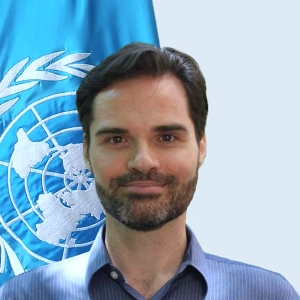
Marko Tosic, PhD, is the lead facilitator for this course. He is an accomplished environmental scientist with over 20 years of experience as a researcher and project manager in the Wider Caribbean Region. His expertise includes water quality, hydrology, environmental pollution, water resources management, environmental monitoring, modeling and policy.